
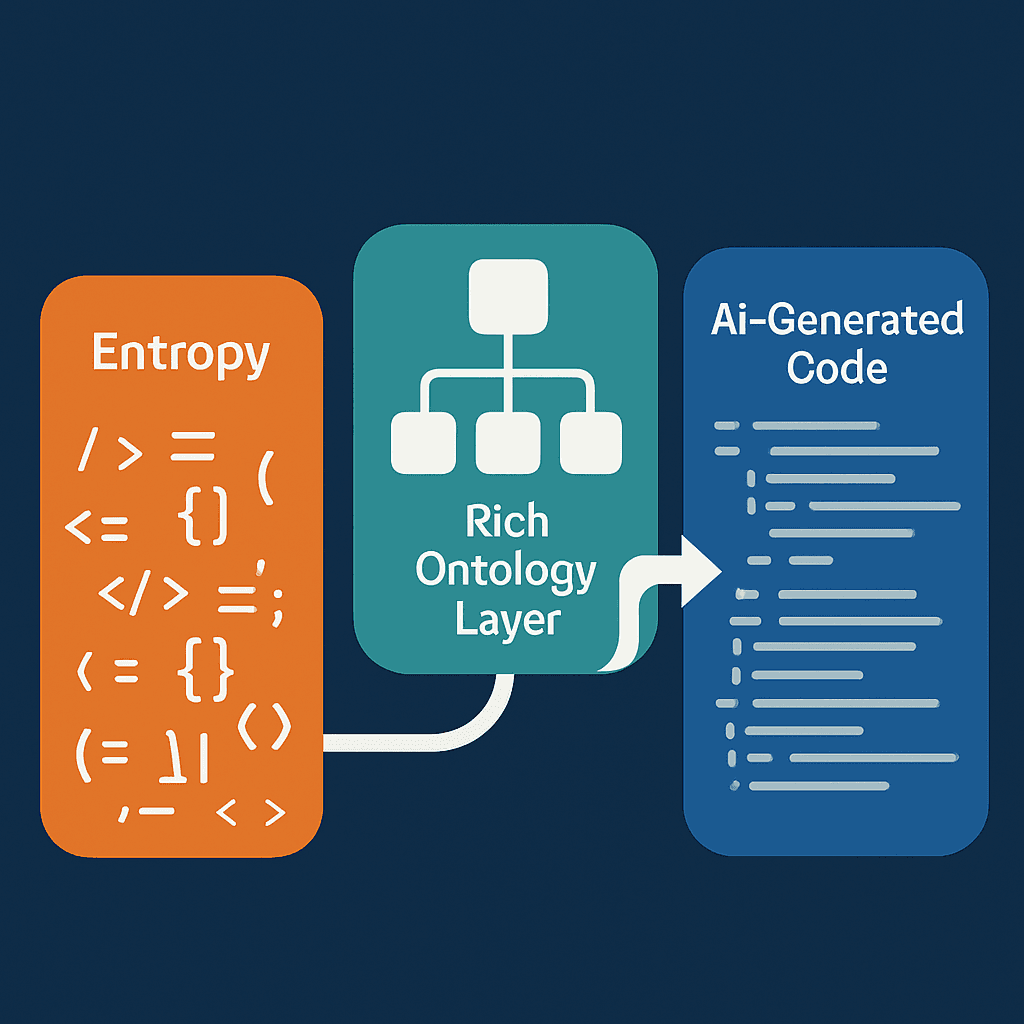

The Core Problems: Entropy, Fragmentation, and Limited Context
One of the fundamental challenges lies in the indeterministic nature of AI outputs. Unlike traditional compilers or strongly typed systems that follow rigid rules, generative AI models operate with a level of randomness. This means that even when prompted with the same instructions, the model may produce slightly different — and sometimes entirely inconsistent — results. This introduces what can be described as entropy in generated code. Such entropy complicates the process of reviewing, validating, and integrating AI outputs into a managed software project. Developers end up spending considerable time debugging and rewriting code that was supposed to save them time in the first place.
Another major limitation is that AI code generation is not holistic. Large codebases demand strict consistency in architectural patterns, naming conventions, data models, and dependency management. Yet current AI systems tend to generate code fragments in isolation. To achieve any kind of uniformity, teams must introduce wrapper agents and complex merging strategies that attempt to reconcile multiple outputs into a cohesive structure. This adds overhead and increases the risk of subtle mismatches that lead to long-term maintainability issues.
Context size presents yet another obstacle. Even with the growing capabilities of large language models, there are still practical limits to how much of a codebase can be fed into a model at once. This makes it especially difficult to handle maintenance and updates on existing systems. Developers cannot realistically re-provide the entire codebase to the model each time they want to generate improvements. Instead, they are forced into piecemeal interactions that risk breaking existing contracts and dependencies.
Put simply, while today’s AI-based code generation tools offer convenience, they are not yet equipped to handle the complexity, reliability, and sustainability required for enterprise-grade development.
Beating the Entropy in AI-Generated Code
This is where Mindbricks comes in with a radically different approach. Instead of trying to directly generate entire codebases from scratch, Mindbricks introduces a rich ontology layer that sits between the developer’s intent and the final code.
By capturing system requirements, design choices, and semantic relationships in a structured ontology, Mindbricks ensures that AI models produce outputs that are semantically consistent across the entire project. The ontology effectively acts as a “blueprint of meaning,” guiding the AI so that it adheres to predefined conventions rather than drifting into unpredictable or contradictory outputs.
Because this ontology is fully managed and enforceable, the generated semantic architecture can be validated at every stage of the process. This allows teams to not only confirm correctness but also maintain confidence that every update will align with the larger system design.
Once the semantic layer is complete, the Mindbricks engine automatically transforms it into reliable, bug-free code. What developers receive is not just a loose collection of generated fragments but a cohesive and maintainable ecosystem, where every component fits neatly into place. This approach addresses the entropy problem head-on by creating deterministic pathways from semantic intent to executable code.
Easier Maintenance Through Semantic Documents
One of the most powerful aspects of Mindbricks’ methodology is how it simplifies the maintenance and evolution of software systems. Since the semantic ontology is concise and abstract compared to the full codebase, it can be easily fed back into an AI model’s context window. This enables developers to request updates, modifications, or optimizations without overwhelming the model with unnecessary details.
For example, instead of feeding millions of lines of source code into the AI, teams can simply provide the semantic document. The AI then updates the ontology according to the new requirements, and the Mindbricks engine regenerates the code in a consistent, controlled manner. This results in a workflow that is not only faster but also far more reliable than current approaches.
Toward a New Standard in AI-Driven Development
The future of software engineering will not be about replacing developers with AI but about empowering them with the right abstractions. Current AI tools fall short because they attempt to shortcut the complexity of code generation without addressing entropy, consistency, and maintainability. Mindbricks recognizes these limitations and solves them by shifting the focus from code to semantics.
By introducing a robust ontology layer, enforcing semantic consistency, and transforming abstract documents into validated code, Mindbricks represents a new paradigm in AI-assisted software development. It provides a bridge between human intent and machine execution, ensuring that AI becomes a true partner in building scalable, dependable, and future-proof software systems.
In short: while traditional AI-based code generation struggles with entropy and fragmentation, Mindbricks provides the missing layer of order, structure, and reliability.